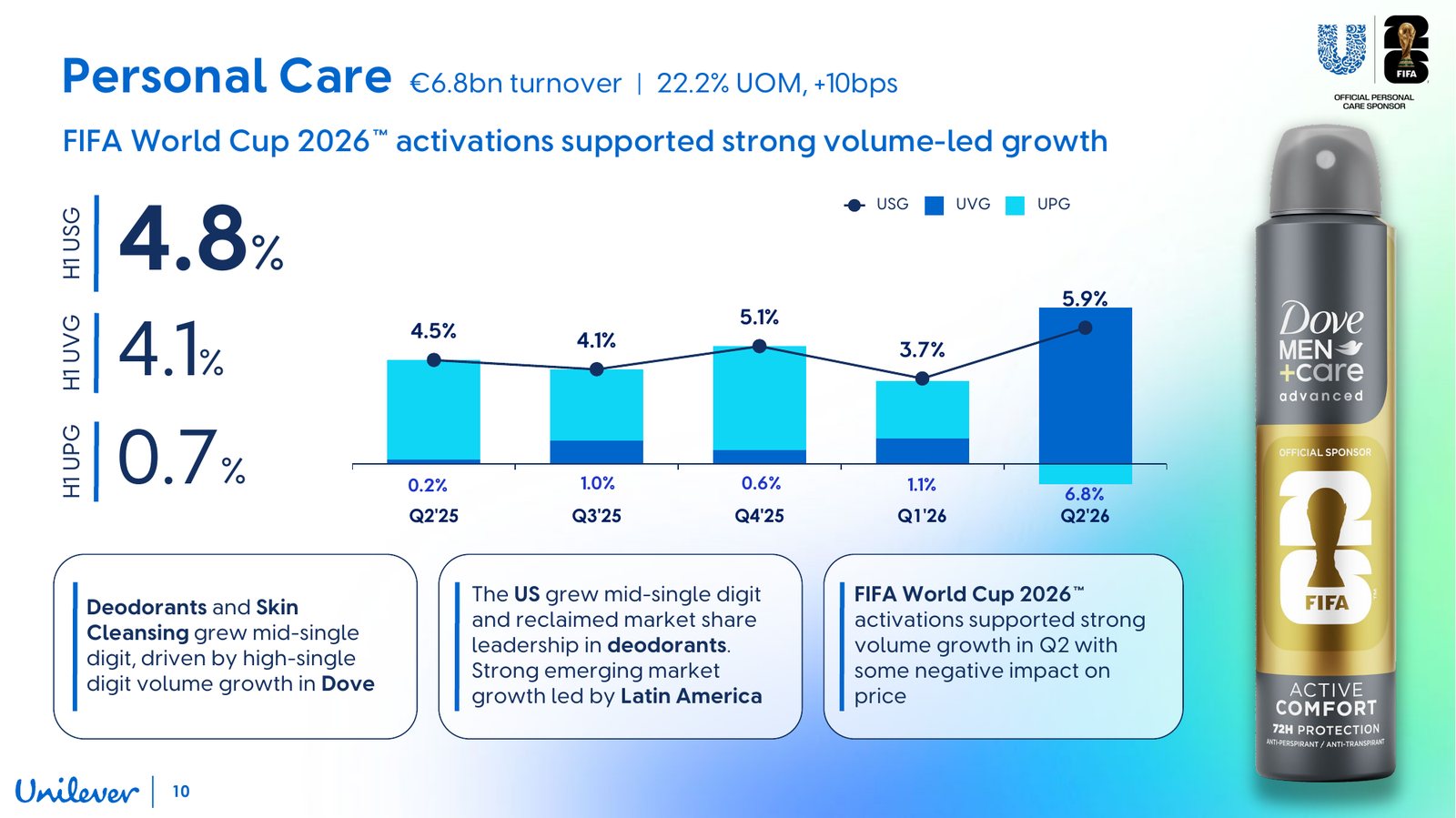
Group-wide, Unilever's second quarter was its best quarterly volume performance since 2010: underlying sales grew 5.8 percent, with 5.5 points from volume and 0.2 from price. Personal Care carried the sharpest version of that story. The division activated 35 brands across more than 120 markets around the World Cup, reaching a claimed 600 million-plus people through more than 50,000 content creators and 180 limited-edition products. First-half turnover reached €6.8 billion, with underlying operating margin holding at 22.2 percent.
The Trade Behind the Volume Number
Chief Financial Officer Srinivas Phatak was direct about the mechanism on the earnings call: “In Personal Care we deliberately elevated promotional support behind FIFA World Cup 2026 activations. These actions enabled us to drive quality volume growth.” The numbers show the cost side of that choice. Personal Care's total sales growth for the quarter, 5.9 percent, ran a full point behind its own volume growth of 6.8 percent. That gap is what the FIFA push cost: the campaign came “with some negative impact on price.” Unilever bought volume with margin, deliberately, inside a single quarter.
The Second Half: Higher Prices, Fewer Promotions
That is not the plan for the second half. Phatak told analysts that “as commodity-related pricing lands in the market and we normalize promotional spend post World Cup, we expect price to lead growth during the second half of the year.” The formal outlook says the same thing in guidance language: full-year underlying sales growth of 4 to 6 percent, but second-half growth of 4 to 5 percent “led by pricing,” not promotion. Any retailer that absorbed Unilever's FIFA promotional density in the second quarter and expects a repeat through the second half is reading against the company's own stated plan. What Unilever has told investors to expect instead is higher list prices, as commodity cost increases land in the market.
“In Personal Care we deliberately elevated promotional support behind FIFA World Cup 2026 activations.”
Where the Growth, and the Cost, Really Sat
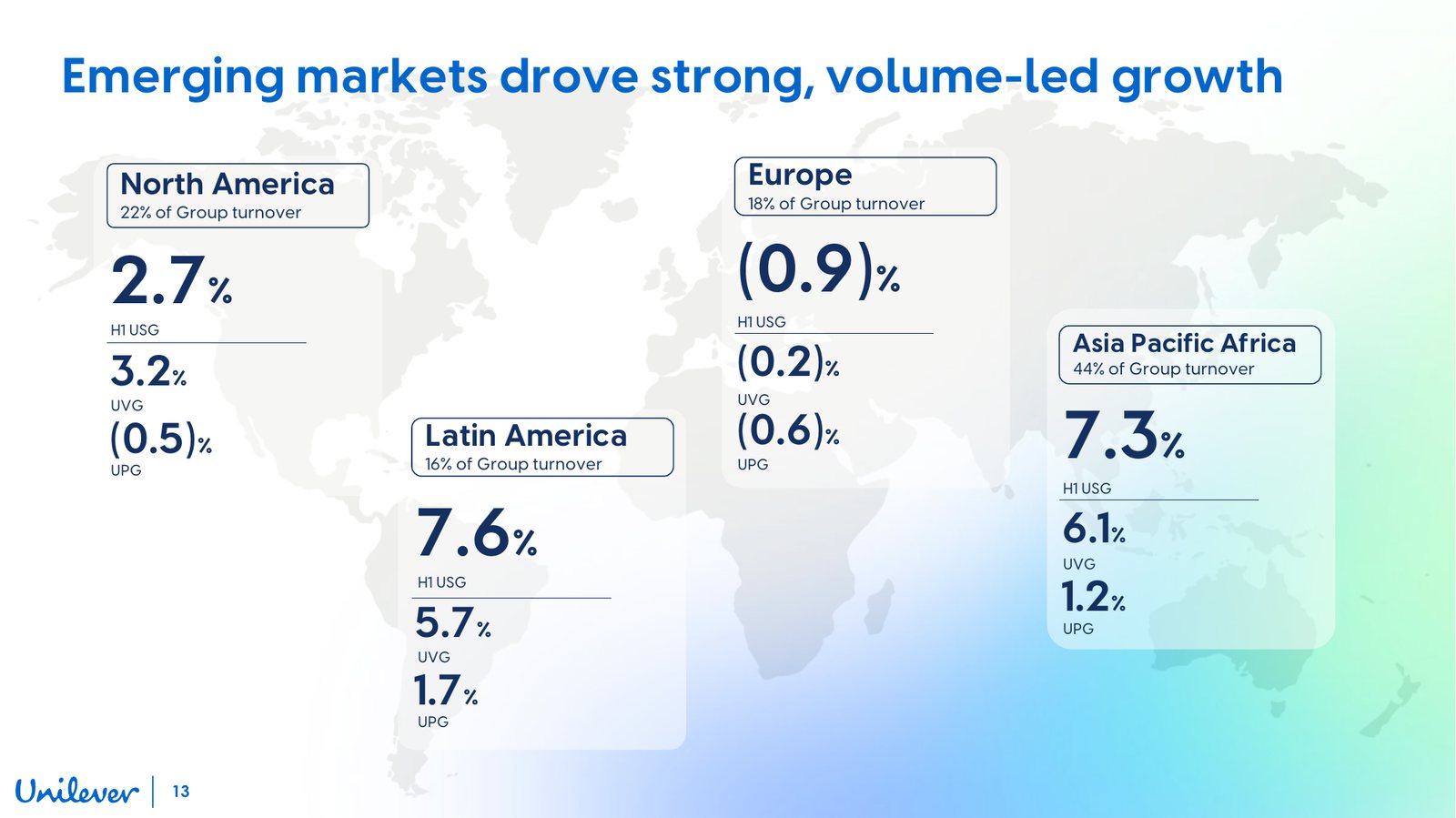
The volume behind Unilever's quarter came overwhelmingly from outside its two largest developed markets. Asia Pacific/Africa, 44 percent of group turnover, grew underlying sales 7.3 percent in the first half. Latin America, 16 percent of turnover, grew 7.6 percent, accelerating to 8.9 percent in the second quarter as Brazil recovered from last year's pricing correction. North America grew 2.7 percent. Europe shrank 0.9 percent.
Unilever does not break out the Middle East; it reports the region inside its Asia Pacific/Africa segment, so there is no Gulf-specific figure. But the Middle East shows up twice as a cost this half: gross margin fell 70 basis points year on year partly on “inflation headwinds arising from middle east conflict,” and the Foods business took longer than planned to close pricing talks with European retailers “due to a need of calibrating the impact of the Middle East conflict in cost.” CEO Fernando Fernandez said Unilever's supply security gave it an edge over local rivals struggling on customer service, “particularly in the category that is more affected, that is laundry powder.”
On paper, this is a marketing win: Unilever's biggest-ever sponsorship and its best volume quarter since 2010. The numbers tell a narrower story. Unilever traded price for volume in one division, paid for it in a single quarter, and says it will not do so again. The Middle East appears only as a cost and a supply-chain advantage, never as a market Unilever is willing to size. Retailers who stocked Personal Care through the World Cup have already had the discounts. What comes next, on Unilever's own account, is higher prices, not more giveaways.
Signal source: Unilever Q2 & H1 2026 Results Presentation and earnings call transcript, 28 July 2026.